Business logic without a map
The real specification lives across source code, database behavior, support tickets, production incidents, and the memories of a few long-tenured people.
Your platform carries years of customer workflows, operational edge cases, and business rules that cannot be replaced with a clean architecture diagram. Next Idea Tech embeds a senior LATAM engineering squad to stabilize fragile systems, recover what the code really does, and modernize high-risk components through controlled releases.
Customer operations, feature delivery, and cutover risk stay visible. Your team regains control of the product.
Bring the current stack, the business pressure, and the part nobody wants to touch. We’ll help define the first responsible slice.
Modernization control plan
One production slice at a time
Baseline critical workflows, incidents, performance, data, and cost.
Turn undocumented rules into tests, maps, telemetry, and decisions.
Isolate a bounded capability with clear interfaces and ownership.
Release, reconcile, observe, and retire only after the gates pass.
Protect
Revenue, workflows, data
Retire
Fragility, waste, key-person risk
Direct answer
Yes, when the work is structured around knowledge transfer, observable behavior, staged ownership, and explicit release gates instead of a blind rewrite. Same-workday overlap with a LATAM team helps domain experts answer questions while the engineer is still in the code, shortening the learning loop around undocumented rules, incidents, and cutovers.
When technical debt becomes business risk
Legacy is not a date on a framework. It is the point at which changing the system feels more dangerous than leaving it alone.
That cost rarely appears as one budget line. It appears as weeks lost to small changes, engineers avoiding critical modules, cloud spend nobody can explain, and roadmap commitments slipping because every feature crosses the same brittle code.
The real specification lives across source code, database behavior, support tickets, production incidents, and the memories of a few long-tenured people.
Customers still expect features while engineering capacity is consumed by brittle modules, manual workarounds, and recurring production issues.
A small change has an unpredictable blast radius. Deployments depend on tribal knowledge, manual checks, or a person who cannot ever take a vacation.
Customer records, billing, audit history, or operational data must move without silently changing meaning, ownership, or reconciliation rules.
Infrastructure has grown organically. Old services stay alive because dependencies are unclear, while incidents and manual releases absorb senior engineering time.
Every departure increases risk because architecture decisions, recovery steps, and edge cases were never turned into tests, diagrams, or runbooks.
The goal is not to make the stack fashionable. It is to make the product safe to change again.
The right treatment for each capability
The right answer is rarely “rewrite everything.” We choose the least disruptive path that can deliver the outcome, and make the tradeoffs visible before implementation begins.
Leave it · Path 1
Modernization is not a mandate to change every component.
Retain
Leave a sound component alone when changing it creates no meaningful business value.
Decision cue: Stable, supportable, and not blocking the roadmap.
Retire
Decommission functionality, data paths, or infrastructure the business no longer needs.
Decision cue: Low usage, duplicated capability, or no accountable owner.
Move it · Path 2
Sometimes the application can stay largely intact while its operating platform changes.
Rehost
Move the existing workload with little or no application change.
Decision cue: A hosting constraint is urgent and code change can wait.
Replatform
Change the runtime, database, deployment model, or cloud foundation with limited application changes.
Decision cue: Unsupported technology or operational overhead is the constraint.
Improve it · Path 3
Preserve valuable behavior while reducing the cost and risk of every future release.
Refactor
Improve internal code structure while preserving the observable behavior customers rely on.
Decision cue: The product works, but high-change code is tangled or hard to test.
Rearchitect
Change system boundaries or component interactions to remove a structural constraint.
Decision cue: Coupling, scale, resilience, or team ownership is the blocker.
Change the bet · Path 4
A selective replacement can be responsible. A blanket rewrite has to earn its case.
Replace
Move a commodity capability to a supported product, service, or SaaS platform.
Decision cue: Custom ownership no longer creates an advantage.
Rebuild
Rewrite a bounded capability when the current implementation cannot economically support the required future state.
Decision cue: Evidence shows repair would cost more than controlled replacement.
The recommendation is an output of the assessment, not a conclusion we bring into it.
Start with a bounded decision
A modernization program should not begin with a large budget and a vague promise to “move to the cloud.” It should begin with evidence.
We trace the workflows the business cannot afford to lose, identify where technical risk is blocking growth, and test the assumptions behind the target state. Leadership receives a defensible investment decision. Engineering receives a plan it can execute.
A real stop / proceed decision
The assessment can recommend proceeding, adjusting the treatment, buying a supported product, retaining the current capability, or pausing. It is not an automatic commitment to a long implementation.
Decision artifact
Modernization assessment
Current-state architecture and dependency map
Critical workflow and business-rule map
Ranked technical and operational risk register
Delivery, reliability, performance, and cost baselines
Treatment matrix by system capability
Target-state options with constraints and tradeoffs
Prioritized first 90-day execution sequence
First production slice with acceptance and cutover criteria
Enough evidence to choose a path, not a slide deck that repeats what you already told us.
Designed for production reality
The operating rule
A phase moves forward only when the evidence supports the next decision.
Delivery phase
Phase 01
We interview product, engineering, operations, support, and the people carrying institutional memory. We review code, infrastructure, databases, deployments, incidents, dependencies, and cloud costs to document what the platform actually does.
Working outputs
Decision gateAgree on the first bounded capability and the business outcome it must improve.
Delivery phase
Phase 02
Before changing core behavior, we make the affected path observable and testable. Characterization tests record what the system does; product and domain owners decide what must be preserved, corrected, or retired.
Working outputs
Decision gateConfirm the workflow can be changed, measured, and recovered responsibly.
Delivery phase
Phase 03
We create a controlled seam around a useful capability, migrate logic and data, and introduce the modernized path gradually where the architecture allows. Feature flags, shadow traffic, parallel operation, and staged migration are useful tools, but they are not automatic promises.
Working outputs
Decision gateValidate behavior, data, performance, support readiness, and production ownership.
Delivery phase
Phase 04
Traffic moves only after agreed gates pass. Old components are retired after usage and dependencies are verified. Architecture decisions, runbooks, ownership maps, and operating knowledge stay with your team.
Working outputs
Decision gateRetire the old path only when the new one is proven and an accountable owner accepts it.
Nearshore is an operating advantage
“Why is this table duplicated?” “Is that scheduled job still required?” “Can this report be one minute late?” Legacy work creates questions all day. US-workday overlap turns them into same-day working sessions instead of tomorrow’s blockers.
A bounded engagement for leaders who need a defensible direction, a first production slice, and an investment plan before funding a larger program.
A senior cross-functional nearshore team that owns defined slices from discovery through production, with joint governance and explicit release gates.
Modernization engineers who join your architecture, application, platform, data, or QA team when you already own the roadmap but need capacity or specialist depth.
Built around the risk
Modernization programs stall when architecture, product context, testing, data, and release ownership sit in separate queues. We assemble the roles the system requires and change the composition as the risk changes.
Your domain owner is part of the team.
We concentrate their time into discovery, business-rule decisions, reviews, and release gates, not daily vendor supervision.
01Modernization lead
Owns current-state discovery, target-state tradeoffs, architectural boundaries, and the technical decision record.
02Senior application engineers
Work across current and target stacks, recover business behavior, create seams, and take bounded changes into production.
03QA automation / SDET
Builds characterization, regression, integration, performance, and acceptance coverage around the path being changed.
04Platform, cloud, or data engineer
Owns infrastructure, observability, security controls, migration tooling, reconciliation, and operating-cost visibility where needed.
05Delivery lead
Keeps risks, dependencies, decisions, stakeholder updates, and production gates visible without adding status-meeting theater.
Modernization in practice
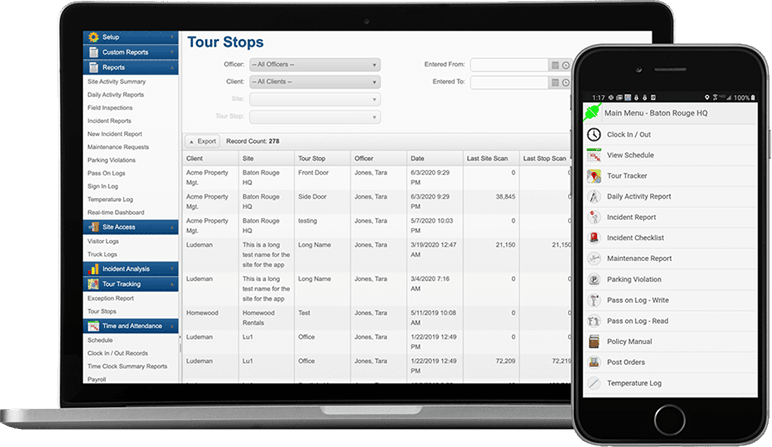
Officer Reports supports GPS-verified tours, time and attendance, incident reporting, scheduling, billing, and customer reporting for security firms. The product was valuable. Changing it was the problem.
A senior LATAM squad modularized the .NET MVC application, rebuilt brittle front-end workflows in Angular, added regression testing and gated CI/CD, improved observability, and reviewed SQL Azure, storage, and App Service resources.
30%
lower Azure spend
700+
security firms supported
.NET + Angular
modernized product stack
Read the Officer Reports case study“Despite the complexity of the project’s requirements, the team has been able to follow deadlines. They also show strong coordination skills even with multiple stakeholders.”
Case-specific result
The 30% Azure reduction is an Officer Reports outcome, not a blanket modernization promise.
Clear ownership
We own delivery without pretending an outside team can make business-risk decisions alone. Responsibilities are explicit before engineers enter the most sensitive parts of the product.
| Area | Your team owns | Next Idea Tech owns | Shared decision |
|---|---|---|---|
| Business direction | Priorities, domain decisions, constraints | Impact mapping and technical options | Sequence and investment decisions |
| Engineering delivery | Standards, access, architecture context | Implementation, QA, documentation | Acceptance and release gates |
| Data and cutover | Data ownership, RTO/RPO, risk authority | Migration, validation, rehearsal | Go / no-go and contingency |
| Knowledge transfer | Named technical and domain counterparts | Runbooks, records, pairing, handoff | Long-term ownership map |
What we will not do
Sell a rewrite before reading the code.
Measure progress by lines or services replaced.
Move critical data without validation and rehearsal.
Hide tradeoffs behind velocity theater.
Modernization FAQ
No “seamless transformation.” No universal zero-downtime promise. Just the constraints, controls, and ownership a real modernization program needs.
Review modernization cost rangesLegacy software modernization is the process of making an existing application safer, faster, and less expensive to change. It can include stabilization, testing, refactoring, runtime upgrades, cloud or data migration, rearchitecture, selective rebuilding, or replacing commodity components. Age alone does not make software legacy; operational risk and change cost do.
We evaluate business differentiation, current reliability, change frequency, dependency risk, operating cost, testability, data complexity, team capability, and cutover constraints. Different parts of one product often need different treatments. The assessment makes those tradeoffs visible instead of forcing the whole system into one migration strategy.
Often, yes. Depending on the architecture, we use bounded releases, feature flags, backward-compatible interfaces, staged data moves, parallel operation, or gradual traffic shifts. Some systems still require a planned maintenance window or temporary change freeze. We identify that constraint early rather than hiding it behind a universal zero-downtime promise.
Usually, but modernization consumes real capacity. We make the allocation between roadmap delivery and risk retirement explicit, then choose modernization slices that unblock valuable product work. High-risk cutovers may need planned release windows. The objective is deliberate sequencing, not the fiction that modernization has no effect on the roadmap.
We triangulate source code, databases, logs, production behavior, incidents, support cases, and interviews with subject-matter experts. Characterization tests capture the current behavior around the area being changed, while product owners decide whether each behavior should be preserved, corrected, or retired. The recovered knowledge becomes tests, system maps, architecture records, and runbooks.
We assess schema and data quality, define transformation ownership, choose a full-load and synchronization approach, reconcile source and target, rehearse the cutover, and document go/no-go thresholds. The plan includes rollback or fail-forward handling and explicitly accounts for transactions created after go-live. The exact controls depend on data volume, write rate, dependencies, and consistency requirements.
A bounded capability can sometimes move in weeks; a business-critical platform may require several quarters of staged work. The responsible first commitment is a timeline for assessment, stabilization, and the first production slice. Evidence from that slice produces more credible estimates for the remaining portfolio than a speculative end date made before discovery.
Cost depends on the system surface, business criticality, data and integration load, test coverage, security constraints, target architecture, and team model. We scope the assessment and first slice before proposing a sustained squad. For planning ranges, use our custom software development cost estimator and then validate the assumptions with the actual system.
Yes. We can provide a managed modernization squad or embed specialists inside an existing team. Architecture authority, repository and environment access, release authority, code ownership, and escalation paths are made explicit at the beginning so work does not fall between organizations.
Modernization creates questions throughout the day: why a rule exists, whether a report can lag, which system owns a record, and when a release can move. LATAM engineers can overlap with US business hours for live investigation, pairing, architecture reviews, incident response, and coordinated cutovers. The advantage is a tighter learning loop, not just a lower rate.
Methodology references
Technical approach reviewed by Next Idea Tech engineering leadership on August 13, 2026.
Start with the part creating the most risk
Show us the workflow that cannot fail, the module blocking the roadmap, or the cloud bill nobody can explain. We’ll separate urgent stabilization from long-term modernization and define the first responsible production slice.
The first conversation is about the platform, its constraints, and the next decision, not a generic transformation pitch.