
You need an ML engineer when:
You have 6-12 months of labeled or labelable proprietary data, a business problem that improves with more of your own data, recurring inference at scale, and differentiation that comes from owning the model.
Senior LATAM ML engineers who own the full model lifecycle: data pipelines, training, evaluation, deployment, monitoring, and drift detection. Not LLM API wrappers — engineers who build models on your proprietary data. Embedded into your team in under 14 days.




When teams want to hire ML engineers, they may search for ML engineers for hire, remote machine learning engineers, or machine learning engineers in Latin America. The real requirement is the same: vetted talent who can build, deploy, monitor, and improve proprietary models inside your existing team.
A senior ML engineer builds and operates production machine learning systems trained on your proprietary data. The work sits between data engineering and applied research: data pipelines, model selection, evaluation, deployment, monitoring, and continuous retraining. ML engineers create proprietary models that competitors cannot easily replicate — and that is the business case.
The most common ML hiring mistake is hiring the role before the data foundation exists. A senior ML engineer should be able to tell you whether the model is the next step, or whether the pipeline is.
The titles overlap. Here is the practical distinction we use when matching engineers to your roadmap. See all AI engineering specialties when you need the broader map, or hire an LLM engineer instead if your roadmap is built on foundation models. For the surrounding platform work, see senior Python developers — the foundation language for ML.
| Role | Best fit when... | Typical scope |
|---|---|---|
| ML Engineer | You have proprietary data and a business reason to build custom models: ranking, recommendation, fraud, forecasting, or classification at scale. | Data pipelines, training infrastructure, model evaluation, deployment, and drift monitoring. |
| LLM Engineer | You're shipping AI features on top of existing foundation models. You don't have proprietary training data, or it is not ready yet. | Prompt design, RAG, evals, fine-tuning of open-weight models, and cost optimization. |
| Data Scientist | You need to understand patterns in data before deciding what to model. Analytics-heavy, with modeling secondary. | Statistical analysis, hypothesis testing, prototype models, dashboards, and attribution. |
| Data Engineer | The data is not clean enough to model on yet. You need pipelines before models. | ETL/ELT, warehouse design, real-time event streaming, and data quality. |
You have 6-12 months of labeled or labelable proprietary data, a business problem that improves with more of your own data, recurring inference at scale, and differentiation that comes from owning the model.
You are prototyping AI features, do not have clean training data yet, or the use case fits comfortably inside a frontier LLM's capabilities. Hire an LLM engineer or data engineer first.
ML is for scaling proven value, not finding it. If the data foundation is missing, even a strong ML engineer spends months doing cleanup before the first model ships.
The US senior ML engineer market is hot and stays hot. Senior ML talent in major markets can push deep into the six figures once equity and bonuses are included, especially when the role touches real-time inference, MLOps, and experimentation infrastructure. Nearshore LATAM ML engineers with equivalent production experience deliver 40-55% cost reduction at the same seniority level.
We do not stop at "has trained a model." We test the production discipline that separates a senior ML engineer from a smart notebook builder.
Can write production-grade Airflow DAGs, understands feature stores, and handles late-arriving data or schema drift without breaking the model.
Comfortable in Kubeflow, MLflow, Vertex AI Pipelines, SageMaker, or W&B. Knows when to use which.
Does not reach for a neural network when XGBoost would win. Designs validation strategies that catch data leakage before production does.
Real-time inference, batch scoring, model serving with TorchServe, Triton, or Ray Serve, plus latency budgets and throughput tuning.
Knows input drift from concept drift from prediction drift. Sets up monitoring before the model goes live.
Statistical rigor. Will not ship a model based on a one-week test that has not reached significance.
Can explain to a PM why a model is performing worse this month even though no code changed, and can push back when the data cannot support a prediction.
The senior signal: reproducibility, model versioning, lineage, governance, and the boring discipline that keeps ML sustainable.
The question bank from 2019 will not filter ML candidates correctly in2026. Our process tests data judgment, validation strategy, production deployment, drift monitoring, and whether the engineer can work inside your real delivery process.
We look for shipped production AI, not notebook demos. We want real product work, messy constraints, user behavior, and systems that survived production.
Every ML engineer candidate gets a messy dataset and prediction target in the technical interview. We watch how they handle leakage, class imbalance, validation strategy, feature engineering, and production failure modes.
We watch how they reason through a realistic product problem, open tradeoffs, handle edge cases, and explain what they would ship first.
We confirm fluent business English, async-writing skill, and meaningful US working-hour overlap for standups, pairing, planning, and code review.
We confirm their track record with real references - past tech leads, not friends - and look for the habits that make remote engineering work.
We handle payroll, IP assignment, NDAs, and local-labor-law compliance in LATAM, then keep a close feedback loop after placement.
Founder-led staffing for teams that need production AI engineers who can move inside real codebases and ambiguous product constraints.
Next Idea Tech turned my hacked-together prototype into something investors and customers actually trust. They owned the UX, dev, and infra like an in-house team.
Despite the complexity of the project's requirements, the team has been able to follow deadlines. They also show strong coordination skills even with multiple stakeholders. Above all, Next Idea Tech, Inc provides competent developers to ensure seamless collaboration.

Next Idea Tech, Inc guided an efficient process to deliver valuable insight that supports business goals. The team provided one point of contact who communicated effectively. A capable team, they produced work that satisfied expectations.

The team's deliverables and solutions have made it possible for the client to more effectively and efficiently run their business. Their ability to listen to project requirements and reflect them in a final product was refreshing for the company. The project manager was skilled and professional.

...Next Idea Tech produces high-quality code and communicates with in-house staff on a daily basis to streamline the work. They're a transparent team that gives projects the utmost attention, making clients feel like they're the only ones they're tending to.

Since the company partnered with the Next Idea team they've noticed an increase in engagement from their audience. Visitors to the website often return and find the platform easier to navigate. The company was most impressed by the team's professionalism throughout the project.

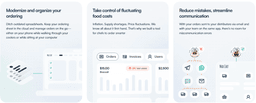
MadChef completely changed how we handle our inventory. We're finally seeing where every dollar goes and saving thousands every month. The integration with QuickBooks and our distributor price sheets is seamless. It's the only tool we use daily to protect our margins.
Short answers for the role-disambiguation questions buyers ask before they commit to a hiring path.
One-paragraph brief on your product, stack, role, and timeline. We'll line up matched pre-vetted ML engineers quickly, often within 72 hours.